01
Problem
Ungoverned Intelligence
The problem: data, AI, models, agents, decisions, rules, and institutions operating without sufficient trust, control, accountability, evidence, auditability, and oversight.
Ungoverned Intelligence is written for leaders who must adopt, regulate, fund, audit, secure, or govern AI before weak data, weak ownership, and weak controls become institutional failure.

Inside the book
AI becomes trustworthy when the data, permissions, controls, evidence, accountability, and institutions around it are governed.
The book does not make AI the villain. AI is the amplifier. Weak governance is the failure source. The question for leaders is not only what AI can do. It is whether the institution can prove, control, explain, and answer for the intelligence it uses.
TitleUngoverned Intelligence
SubtitleHow Leaders Can Build Trust Before AI Scales Beyond Control
AuthorFateh uddin B. Mehmood
PublisherVeridica Press
Expected publication15 August 2026
Length780 pages
FormatsHardcover, Paperback, Ebook, Audiobook, Institutional edition, Special hardbound edition
01
Problem
The problem: data, AI, models, agents, decisions, rules, and institutions operating without sufficient trust, control, accountability, evidence, auditability, and oversight.
02
Method
The method: seven governance layers beneath trusted AI, from data foundations to institutional accountability.
03
Destination
The destination: a trusted, secure, accountable, auditable, and scalable capability for using intelligence at organizational and national scale.
Ungoverned Intelligence gives leaders a practical way to see the governance problem beneath AI adoption, explain it clearly, diagnose trust fractures, and build the operating capability required to govern intelligence at scale.
01
A clearer vocabulary for naming the governance problem beneath AI adoption.
02
Real institutional failures and success patterns that make governance memorable.
03
The Trust Stack: a seven-layer architecture for governing intelligence at scale.
04
Practical ways to turn policy statements into assigned, evidenced, monitored, and improved controls.
05
A staged path for the first 30 days, first 100 days, and first 12 months.
The book begins not with an abstract definition, but with a trust collapse. It then moves backward to the oldest foundations of institutional scale before returning to modern AI, autonomous agents, public-sector trust, machine-readable governance, and the governed organization.
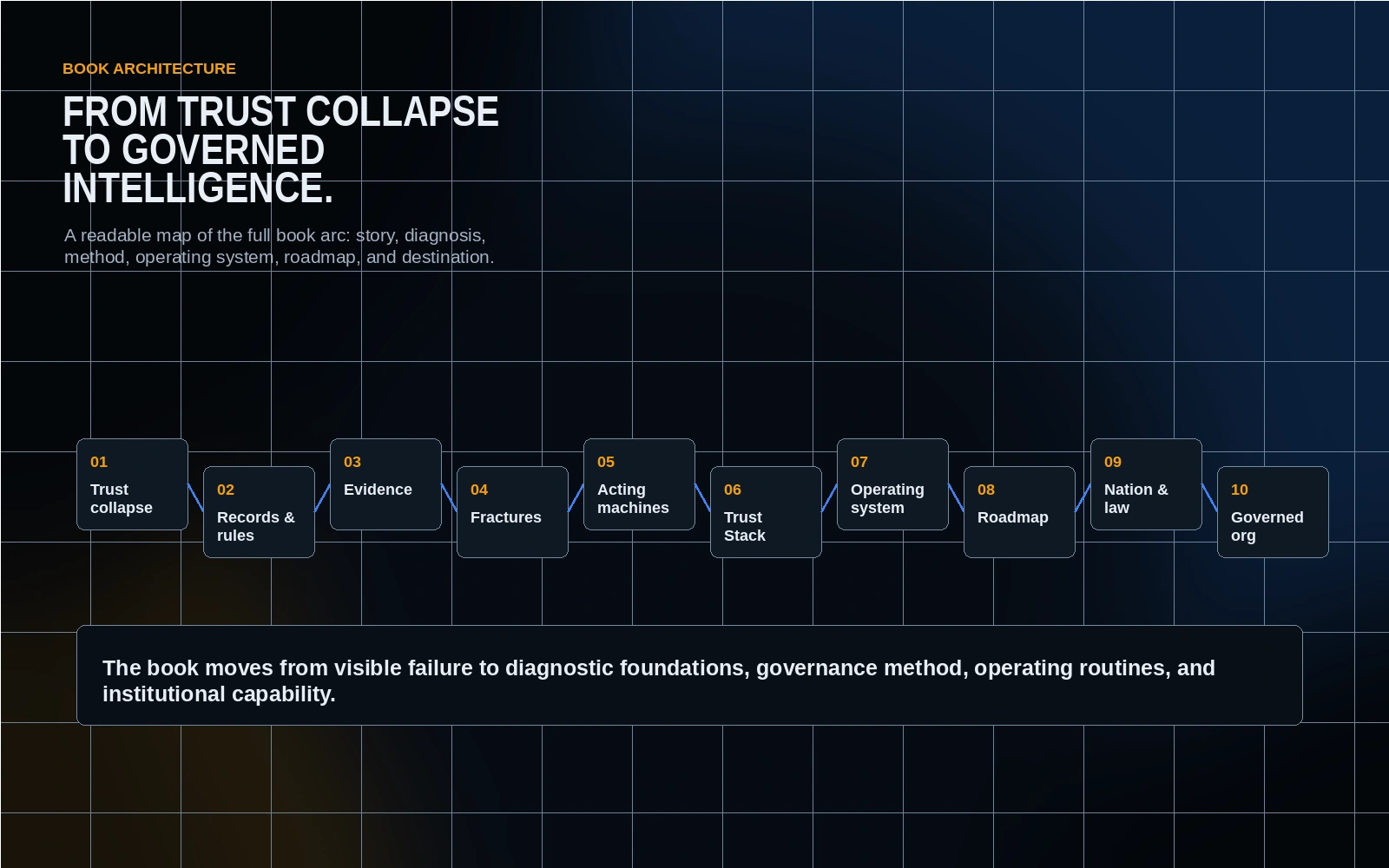
Book architecture
The reader enters through a trust collapse, not an abstract definition.
Governance stops feeling bureaucratic and becomes the infrastructure of scale.
Evidence becomes valuable only when it changes institutional action.
Leaders see the uncomfortable mirror: ownership, quality, permission, accountability, evidence, and control.
The risk changes when systems move from producing answers to taking action.
The central method arrives as relief: a way to govern the layers beneath intelligence.
Governance becomes visible leadership practice through mission control, ownership, controls, and dashboards.
The book becomes executable: 30 days for visibility, 100 days for control, 12 months for capability.
The scale widens from enterprise governance to national readiness and machine-readable governance.
The reader leaves with a leadership choice and practical instruments of action.
The Prologue begins with a trust-collapse case before the book introduces the Trust Stack.